
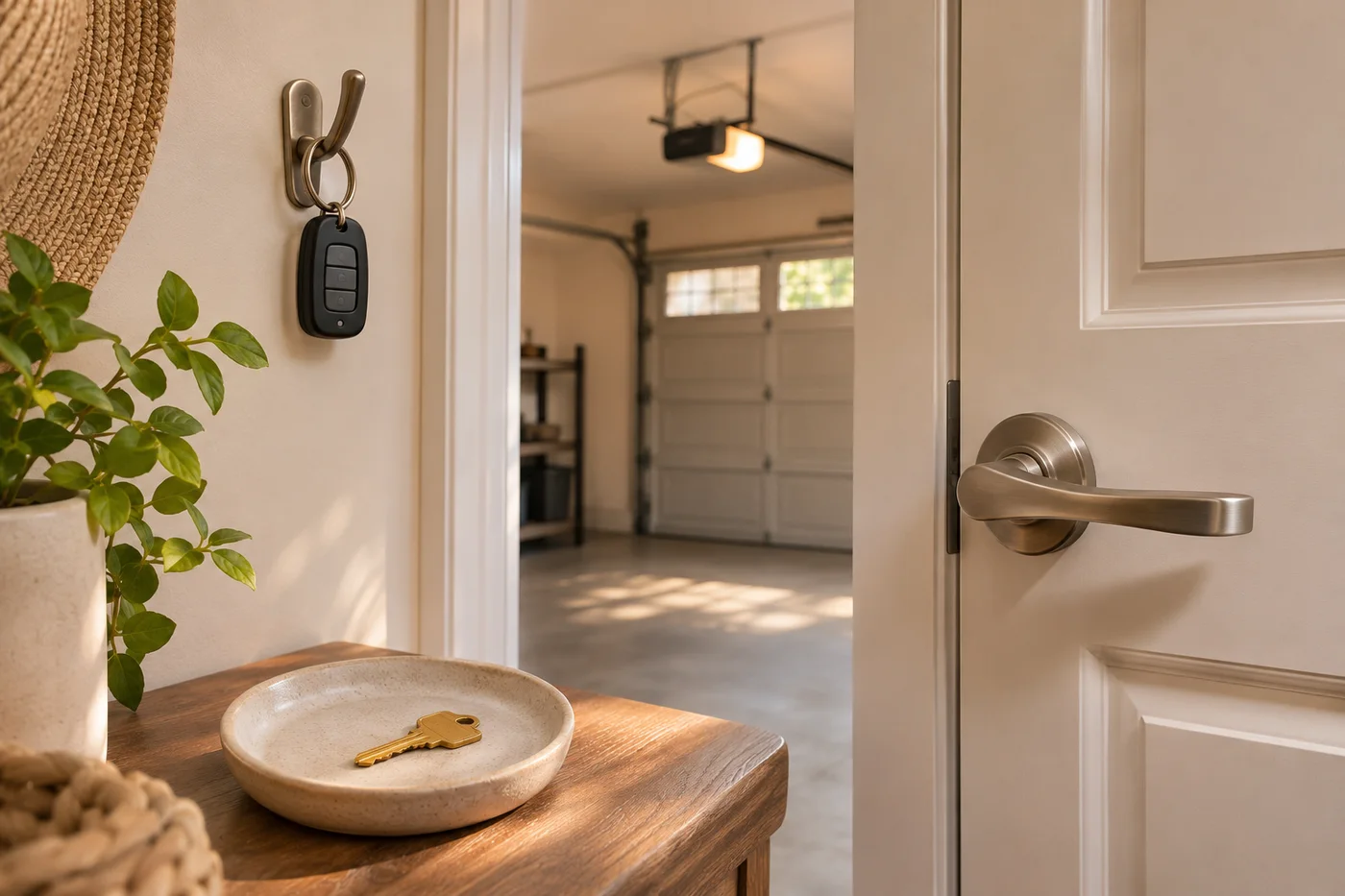
Notice when one route has become the only route
A garage can be the easiest entrance for shopping, school bags and the person arriving late. Over time, a remote may replace the house key in someone's daily routine. That convenience isn't a problem by itself. The difficulty comes when nobody knows where the alternative key is or which door it operates.
For a planned access review, think about each person who normally comes home. Do they carry a physical key, use a keypad, share a remote or rely on someone already being inside? You may find that the household has several routines but only one working route.
The residential locksmith page covers the ordinary locks involved. Keep that work separate from the overhead door. A new key for the door into the house doesn't repair a lifting system, and a new remote doesn't change a house-lock cylinder.
If the garage is damaged, leave that opening alone
A crooked door, loose cable or visibly broken spring is a reason to stop using it and keep people and vehicles clear. Repeated attempts are not needed to make the problem easier to describe. Don't force the opening or detach components to create a route through it.
A safe, already available alternative entrance is a different matter from trying to move a damaged door. If you have ordinary access elsewhere, use that in the plan. If the household is locked out, explain both the access issue and the garage fault when discussing help.
Our Corona garage-door information distinguishes the moving door, opener and controls. If someone is in immediate danger, call emergency services. This guide is preparation for ordinary service decisions, not a set of instructions for bypassing a door or safety device.
Keep physical keys and controls on separate lists
The front-door key, a pedestrian garage lock and a large overhead door can all be called the garage key in conversation. List what each item actually operates. The remote, outside keypad and any app access may also be separate ways to control the opener.
When an access change is being considered, ask which of those items will be affected. A mechanical rekey does not automatically remove a remote. A control change does not tell you whether a missing physical key still opens the house. Have the result explained for the particular equipment.
If you have bought a replacement remote, retain its package and model details. Compatibility needs checking. Don't assume a similar-looking control can be enrolled or that changing settings is a universal answer to every failure. Product-specific instructions matter, especially where safety devices are involved.
A Corona mailing address may need more detail
A home described as Corona may be in the city or in a nearby unincorporated community. Riverside County lists places such as Temescal Valley, Coronita and Home Gardens separately. For a service conversation, the actual street, unit and entrance are more useful than the postal city alone.
The same applies inside Corona. Sierra Del Oro, Eagle Glen and Dos Lagos are distinct local descriptions, but none tells someone which garage door or driveway belongs to the request. If the entrance is managed, give the permitted approach and the person who can approve work.
Read the Temescal Valley or Coronita page for the place. These pages provide local context, not additional storefronts or a guarantee of current availability for every installed opener.
Make the backup useful to the person who needs it
Once the household has ordinary access, check what a spare should achieve. A spare inside the same inaccessible garage won't help with that particular failure. Nor will a key that nobody can identify or a remote left with the person who has gone away.
You don't need to create elaborate records. A short note about the key, the door it operates and the person holding it can be enough. If someone rarely uses the alternative entrance, let them try the agreed key through normal operation while everything is working.
If a lock is catching, put that repair in the plan as well. A backup route is less useful when it depends on the door everyone avoids. Door repair information explains why a new key alone may not correct a latch or fit problem.
After repair, review the route rather than adding another gadget
Have the repaired garage's normal operation explained, including the controls that were included and any existing equipment retained. Keep the work description and written terms. If a remote or keypad change was part of the work, identify which users need updated access.
A household in Eastvale or Riverside may face the same practical questions, while the property and equipment remain different. Separate local garage pages explain those requests without replacing the ordinary locksmith information.
The result needn't be a whole new system. It may be a repaired door, a clear physical spare and a household that knows which entrance to use when the usual one is unavailable. Agree on that useful outcome rather than buying additional controls without a plan.
Questions about the request.
Does a garage remote replace the need for a house key?
Should I release a broken door to get inside?
Can a rented garage be changed by the resident?
Context checked November 9, 2026. Place photographs do not imply a business partnership or completed service job.